Wearable devices used to be easy to understand. They counted steps, estimated calories, measured heart rate and gave users a rough picture of how active they had been. That world has changed quickly.
The most interesting devices are no longer simple fitness trackers. They monitor sleep, recovery, stress, strain, blood oxygen and heart rate variability. But more importantly, they try to interpret that information — and that shift is where wearable hardware becomes a software challenge.
From measurement to meaning
Heart rate variability is a useful example of the challenge. HRV is a meaningful signal: it can indicate how the body is responding to stress, recovery and training load. But as a standalone number it means very little to most users. They don’t know whether a given reading is good, bad or just typical for them. They don’t know whether it warrants rest, a lighter session, better sleep or nothing at all.
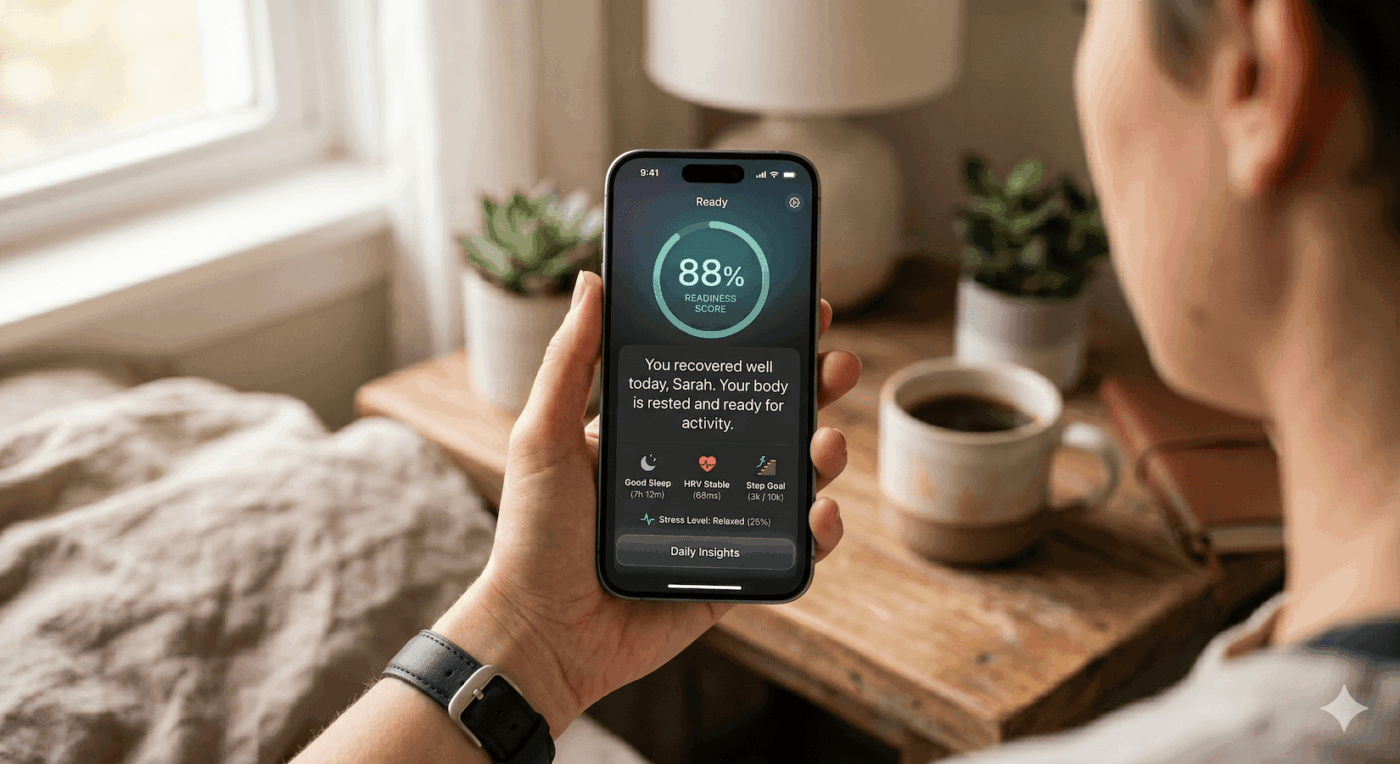
The job isn’t to show the data, it’s to give it context. A well-designed wearable experience might say, in effect: your HRV is lower than usual, your sleep was disrupted and your recent training load has been high, so today may be a day for lighter activity. That’s very different from displaying a chart of last week’s readings and leaving the user to draw their own conclusions.
The same logic applies to sleep scores, readiness scores and recovery recommendations. Garmin’s Body Battery is a good illustration of the approach — a single concept that compresses a physiological picture into something a user can act on. Its value isn’t the accuracy of the underlying model. It’s the design decision to give a complex signal a human shape.
That reduction carries a risk, though. A single score creates clarity. It can also create misplaced certainty. Does the user understand it’s an estimate? Do they know which signals contributed to it? Do they understand the difference between a wellness recommendation and medical advice? These aren’t hardware questions. They’re product, content and trust questions.
AI is useful when it learns the individual
The most valuable wearable insights are personal rather than universal. An average resting heart rate or HRV range is less useful than understanding what’s normal for a particular user. This is where machine learning has a practical role — not as a marketing claim, but as a way of identifying patterns over time.
A wearable that has observed a user for weeks or months can begin to understand their baseline: how they typically sleep, how long they take to recover, how their HRV responds to alcohol or stress, how their body behaves across different types of activity. Over time the product can surface observations the user wouldn’t have noticed themselves — that they sleep badly after late meals, recover poorly after back-to-back intense sessions, or feel measurably better when they keep to consistent routines.
At its best, this helps people make better decisions without requiring them to become physiologists. At its worst, it produces a stream of overconfident notifications, unexplained scores and anxious self-monitoring. The sophistication of the model matters less than the quality of the experience built around it.
The interface has to protect the user from the data
As devices collect more data, there’s a temptation to show more of it. More charts, more scores, more alerts, more trends. But more information doesn’t create more value — it creates more noise.
A user checking their app first thing in the morning doesn’t need a full physiological report. They may need one clear message: you recovered well, your sleep was disrupted, your body appears to be under strain, or nothing significant needs your attention today. The detail can still be available, but it shouldn’t all compete for attention at the same level.
The interaction might happen while someone is running, commuting, waking up or quickly checking their phone between tasks. The product has to understand context. It has to know when to interrupt and when to stay quiet. The fundamentals of that — glanceability, short sessions, constrained interactions — we covered in Designing for Wearable Devices. Those principles still apply. What has changed is the complexity sitting behind the interface.
Coaching needs a careful tone of voice
Wearables increasingly speak to users in the language of coaching. They tell users to rest, move, breathe, sleep, train, recover or adjust routine. That creates a tone-of-voice challenge that’s easy to underestimate.
Health feedback is not neutral. A phrase that feels motivating to one user can feel judgemental to another. A score that seems useful at first becomes a source of anxiety if the user starts chasing it daily. Small wording decisions shape that experience significantly.
‘Your recovery appears lower than usual today’ is softer and more honest than ‘Poor recovery detected.’ ‘You may benefit from a lighter session’ is different from ‘Avoid intense exercise.’ ‘Your sleep was more disrupted than usual’ is more useful than ‘Bad sleep.’
The best wearable experiences leave room for interpretation. They treat biometric signals as estimates rather than verdicts. They help users notice patterns without pretending to have complete knowledge of their body or life. This matters particularly as wearables sit closer to digital health: most consumer devices are wellness products, not diagnostic tools, but users will treat their outputs as authoritative if the interface presents them with confidence. Designing responsibly means communicating uncertainty clearly, avoiding unnecessary alarm, and knowing when not to nudge.
This is an area where experience in digital health transfers directly. The conventions of health communication — precision without alarm, honesty without anxiety, guidance without instruction — apply as much to a recovery score as they do to clinical information. The medium is different. The discipline is the same.
What different products teach us about strategy
The leading wearable products show different answers to the same question: how should personal data become useful?
Whoop shows the power of a focused proposition — built around recovery, strain and sleep, with coaching delivered through a subscription app rather than a screen on the wrist. Oura demonstrates that a wearable doesn’t need to demand constant attention to become part of a user’s life; its value comes from passive, low-friction tracking and periodic reflection rather than interruption. Fitbit remains a reminder that accessibility matters: not every user wants advanced analytics, and the most useful product is sometimes the one that makes health data feel approachable rather than technical. Apple shows what ecosystem integration makes possible — the watch is useful not just for what it measures but for how that data connects to everything else.
The question for any product team isn’t which device has which sensor. It’s what kind of relationship the product is trying to build with its user. Is it a coach? A passive observer? A training partner? A calm daily check-in? The answer should shape everything from onboarding and data permissions to notification strategy and visual design.
The opportunity for digital health
The real opportunity wearables offer digital health products isn’t more data. It’s better timing, better personalisation and a more honest understanding of the user’s state.
A rehabilitation tool might use activity data to help users pace recovery. A mental wellbeing product might treat changes in sleep, heart rate or routine as prompts for reflection rather than alerts. A clinician-facing system might summarise trends without overwhelming staff with raw signal.
That means designing for the user’s emotional state as well as their physical measurements. Someone seeing a low recovery score or an elevated stress alert may not need more information. They may need a clear explanation, a calm tone and a small, specific next step.
The challenges of designing wearable health apps aren’t primarily technical. They’re about knowing how to present health information responsibly, how to reduce complexity without losing meaning, and how to build experiences people trust when the subject matter is personal. Those problems are familiar. The data source is new.